

A comprehensive, research-backed framework that goes beyond college admissions to prepare students for lasting success in education, career, and life.
Built on Three Pillars. Measured by Eight Durable Skills.
The Sterling Method™ provides the structure families need to make confident decisions about their student's future. We use it with students in grades 6–16, their families, and partner organizations.
The Three Pillars
Every advising engagement addresses these three interconnected dimensions to ensure comprehensive postsecondary readiness.
Strategic Alignment
We assess aptitude, interests, and constraints to identify the best-fit postsecondary path.
- Comprehensive interest and aptitude inventory
- Family values and constraints mapping
- Career pathway exploration (not just college)
- Cost-benefit analysis of each option
Economic Reality
We connect postsecondary choices to livable wage and cost-of-life expectations.
- Regional labor market analysis
- Salary vs. student debt projections
- Alternative credentialing options
- Return on investment calculations
Durable Human Capital
We assess students on eight essential skills and create personalized development plans.
- Sterling Standards™ baseline assessment
- Gap analysis and prioritization
- Targeted skill development activities
- Progress monitoring and adjustment
The Sterling Standards™
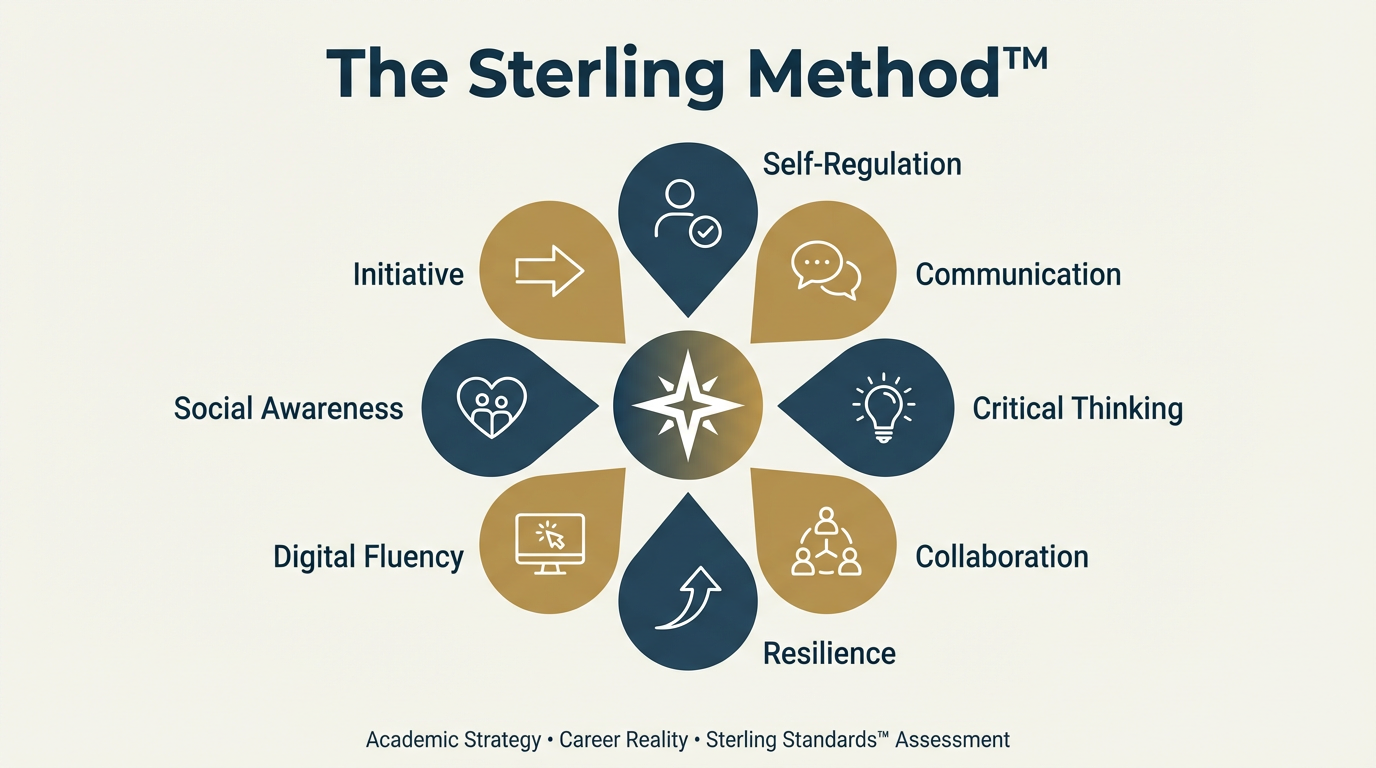
Eight durable skills that schools rarely measure but employers and colleges watch closely.
Each skill is systematically assessed, developed, and tracked throughout the advising relationship.
Self-Regulation
The ability to manage emotions, impulses, and behaviors to achieve goals. Students learn to handle stress, delay gratification, and stay focused during challenges.
Measured through goal-setting exercises, time management audits, and stress response scenarios.
Developed via structured planning sessions, mindfulness practices, and progressive challenge assignments.
Communication
Effective verbal, written, and digital communication. Students articulate ideas clearly, listen actively, and adapt their message for different audiences.
Evaluated through presentations, written samples, and mock professional conversations.
Built through structured feedback loops, public speaking opportunities, and professional writing exercises.
Critical Thinking
Analyzing information objectively and making reasoned judgments. Students question assumptions, evaluate evidence, and solve complex problems.
Tested through case studies, problem-solving scenarios, and analytical writing.
Cultivated via Socratic questioning, real-world problem analysis, and decision-making frameworks.
Collaboration
Working effectively with others toward shared goals. Students navigate group dynamics, resolve conflicts, and contribute meaningfully to teams.
Observed through group projects, peer feedback, and team role analysis.
Strengthened through structured team experiences, conflict resolution training, and peer leadership roles.
Resilience
Bouncing back from setbacks and maintaining effort despite difficulties. Students develop grit, adaptability, and a growth mindset.
Gauged through reflection on past challenges, response to failure, and growth trajectory analysis.
Built through incremental challenge exposure, failure debriefs, and success attribution training.
Digital Fluency
Using technology effectively, ethically, and safely. Students leverage digital tools for learning while maintaining healthy boundaries.
Evaluated through digital portfolio reviews, online presence audits, and technology use patterns.
Enhanced via digital citizenship training, productivity tool mastery, and screen time management.
Social Awareness
Understanding diverse perspectives and showing empathy. Students navigate social contexts appropriately and build meaningful relationships.
Measured through empathy exercises, perspective-taking scenarios, and relationship mapping.
Fostered through exposure to diverse viewpoints, community engagement, and emotional intelligence training.
Initiative
Taking action without being asked, showing entrepreneurial spirit. Students identify opportunities, take calculated risks, and drive their own success.
Tracked through self-directed projects, opportunity identification exercises, and proactive behavior logs.
Cultivated via independent project requirements, entrepreneurial challenges, and leadership opportunities.
Download the Ultimate Pathway Guide
Get a comprehensive overview of seven postsecondary pathways, including trade-offs, costs, and key questions to discuss as a family. Start your postsecondary planning journey today.
Get Your Free GuideHow We Apply the Method
Whether you're a parent seeking guidance for your student or an institution looking to implement comprehensive programming, here's how we work.
For Families
- 1Initial consultation to understand goals, concerns, and constraints
- 2Sterling Standards™ assessment to establish baseline skill levels
- 3Strategic alignment session to explore postsecondary options
- 4Personalized 30/60/90-day roadmap with specific action items
- 5Ongoing support and progress monitoring
For Schools & Organizations
- 1Discovery session to assess current programming and gaps
- 2iROI™ analysis to evaluate instructional investments
- 3Customized implementation plan aligned with organizational goals
- 4Staff training on The Sterling Method™ framework
- 5Ongoing partnership with data-driven progress reviews
Ready to Apply The Sterling Method™?
Take the first step toward building durable skills and making confident postsecondary decisions.